







Butaleja– Uganda is inching closer to a major agricultural breakthrough as scientists finalize testing of new aromatic rice varieties set to replace the popularly imported basmati and supa rice.
The innovation has been driven by the soaring demand for aromatic rice, which sent researchers at the National Agricultural Research Organisation (NARO) racing to deliver homegrown basmati and supa varieties that can match imported grain in quality, aroma, and yield.
Developed under the Promotion of Sustainable Rice Development (ECO-PRiDe) Project and funded by the Japan International Cooperation Agency (JICA), the new varieties signal a turning point that could boost farmer incomes, strengthen food security, and save the country billions spent annually on rice imports.
Dr. Jimmy Lamo, a rice breeder and Cereals Program Leader at NARO, said the varieties also address long-standing challenges faced by rice farmers in Uganda.
“These aromatic varieties dominate the market, but the ones currently grown in Uganda are highly susceptible to disease and give low yields,” Dr. Lamo noted, adding: “We have now developed improved lines using resistant parent seeds. They are under advanced testing across six locations including Doho Irrigation Scheme in Butaleja.”

He made the remarks on the sidelines of the second Joint Technical Committee (JTC) Meeting of the Eco-PRiDe Project, held on 11 December 2025 at City Resort Hotel in Butaleja District.
Hosted by NARO’s Buginyanya Zonal Agricultural Research and Development Institute (BugiZARDI), the meeting brought together researchers, policymakers, and development partners to review advances in sustainable rice production.
Dr. Lamo revealed that farmers, millers, and value chain actors are participating in cooking and milling evaluations as part of the final assessment before approval is delivered by the Ministry of Agriculture, Animal Industry and Fisheries and the National Variety Release Committee.



Responding to the concerns of rice growing on the environment, Dr. Titus Alicai, Director of Research at the National Crops Resources Research Institute (NaCRRI) and National Project Coordinator for Eco-PRiDe, noted that the project was developing an evidence-based blueprint on how to raise productivity while reducing the environmental footprint of rice production.
“We want to increase rice production without harming the environment, while improving incomes for rural farmers,” he explained.
“This includes producing high-quality seed, strengthening farmer knowledge on sustainable cultivation, and improving the entire rice value chain.”
Now in its second year of implementation, the five-year project brings together researchers, extension officers, seed companies, farmers, academia, and government agencies. It directly aligns with NARO’s Strategic Plan 2025–2030, particularly on building climate-resilient agricultural systems.
Dr. Kisho Miyamoto, the Chief Advisor for the Eco-PRiDe project, said they were leveraging on Japan’s more than 2000 years’ experience in rice production to enhance production and production in Uganda.



“More importantly, we are ensuring last-mile delivery, bringing quality seed, disease control knowledge, and sustainable cultural practices directly to farmers,” Dr. Kisho said.He said the project was facilitating young researchers undertake studies at different Japanese universities.
He emphasized the Musomesa Field School approach, introduced under the project, as a key tool in strengthening the research-extension continuum and localizing farmer learning.
Dr. Nasser Kasozi, Director of Research at BugiZARDI, noted that at Doho Rice Scheme, many farmers have already adopted improved production technologies introduced through the project.
He added that the project is also exploring rice–fish integration technologies, allowing nutrient-rich fish pond water to boost rice productivity and leading to stronger food and income security for rural households.
He revealed that BugiZARDI is also developing a cropping calendar to enhance water-use efficiency and improve yields.
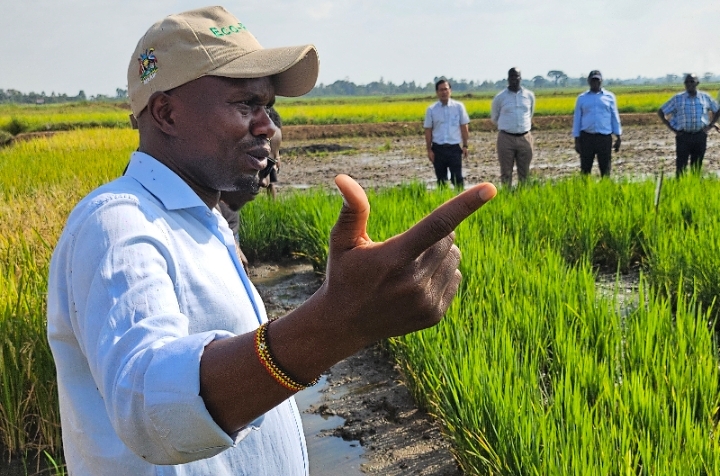
During a site inspection at Doho Irrigation Scheme, the committee observed that with new aromatic varieties nearing release and farmer-focused innovations taking root, Uganda is steadily advancing toward a more productive, competitive, and sustainable rice sector.