
President Museveni opens 4th African Judicial Dialogue
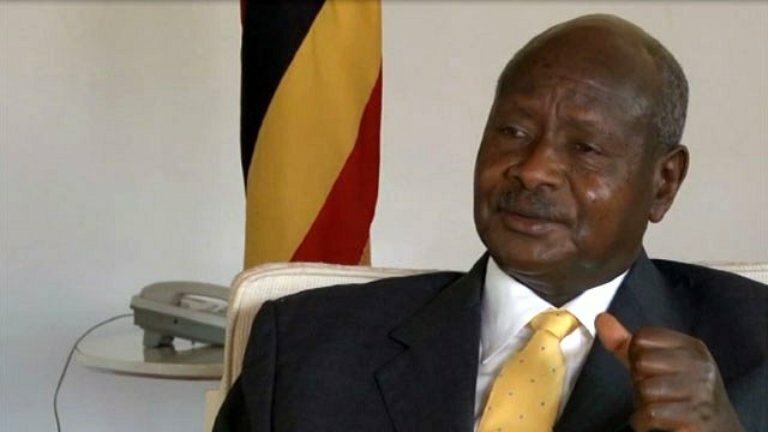
President Museveni at the launch
PRESIDENT Yoweri Museveni has today 30th October opened the 4th the
4th African Judicial Dialogue at Speke Resort Munyonyo.
The conference has attracted over 43 participants from African states
and will run under theme; ‘Tackling Contemporary Human Rights Issues:
The Role of the Judiciary in Africa’.
Museveni called upon the different state and non-state actors to
devote to promotion of justice and human rights in Africa and should
address the causes of injustices and human rights abuses that are
deeply rooted in the social, economic and cultural set up of the
African society.
Most causes of human rights abuses are not of legal nature hence
cannot be addressed my mere legislation, the president said.
“There are fundamental human rights such as the right of access to
food, shelter, clean water, clothing, education and health. These
cannot be addressed legally but rather by developing the economy to
enable the state to support her citizens.
Man has not only been abused by fellow man. He has also been abused by
nature such as floods, drought, diseases, famine and earthquakes,
among others. These can only be addressed by development solutions and
not by legislations,” Museveni said.
He added that political and
social rights could be safeguarded by
legislations, however, most African countries are faced with a danger
of imposing on their people and their laws, liberal concepts of the
developed world that cause a clash of African and European cultures;
that has made safeguarding of human rights in Africa hard.
He added: “The legal system in Africa is merely transplanted from the
West and needs to be harmonised. Some people are, for example, against
the death penalty but for me, I am for the laws of Moses of an eye for
an eye, a tooth for a tooth. Laws should be aligned to society
otherwise some laws may end up being an injustice to the population.
Some of our cultures have been outlawed but people have ignored the
laws and continued to practice their cultures because they see no harm
in them. So, the existences and practices continue; which shows that
those who designed the laws never did enough consultation to put
people’s cultures and norms into consideration because not all African
practices are bad.
About the issues of case backlog, I suggest that the judiciary all
over Africa prioritise cases that are major. For instance, if you have
a case of two men who fought in a bar and a company employing 2000
people, I would think you consider the latter. Let the two men who
fought in a bar wait.”



0 comments