





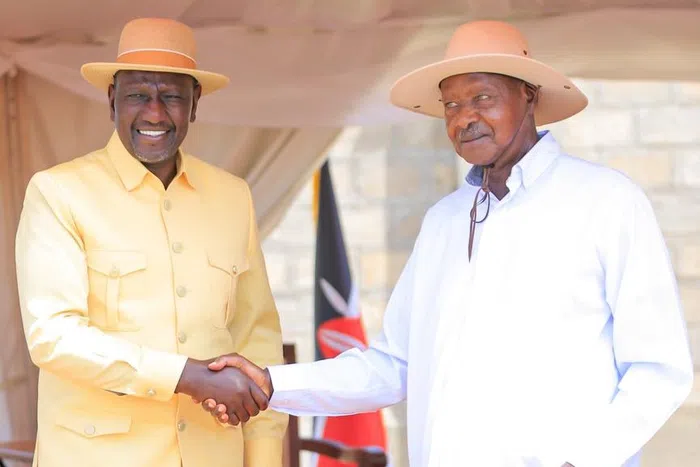
While defending his country’s high fuel prices, Mr Ruto said Kenya should not be compared with neighbours such as Uganda and Tanzania because they are less developed. President Ruto defended Kenya’s higher fuel prices by claiming Kenya is a “middle-income” nation while labeling neighbors like Uganda and Tanzania as “least developed” countries with cheaper costs.
Ruto also asserted that Kenya’s 20,000km tarmac network exceeds the combined total of the rest of East Africa, a claim Tanzania’s Minister for Works later rejected as mathematically incorrect.
While Ruto cited development status for the price gap, regional data shows Uganda and Tanzania maintain lower pump prices despite also being categorized as lower-middle-income economies.
Kenya President William Ruto raised eyebrows across East Africa with comments in which he labeled his neighboring countries as underdeveloped.
Related News

While defending his country’s high fuel prices, Mr Ruto said Kenya should not be compared with neighbours such as Uganda and Tanzania because they are less developed.
Speaking on April 19, 2026 during a church service at Karen Africa Gospel Church in Nairobi, Ruto said, “I know many people in Kenya keep asking why it is that sometimes the prices of fuel are different in Kenya from our neighbors. Kenya is a middle-income country. Our neighbours are least developed countries.”



He added, “There is a big difference. If you want to compare Kenya fairly with others, compare Kenya with other middle-income countries.”
The remarks followed a steady rise in Kenya’s fuel prices in the wake of the crisis in the Middle East.
On April 15 Kenya increased petrol prices to 206.97 Kenyan shillings per litre (UGX 5936)and diesel to 206.84 Kenyan shillings (UGX 5932) before a later VAT-related adjustment.



As of April 20, 2026, petrol in Uganda stood at about UGX 5,290 per litre, and Tanzania at about TZS 3,820 per litre.
On diesel, Uganda was at about UGX 5,090 per litre, compared with TZS 3,806 in Tanzania.
Tanzania’s own April cap-price notice also listed Dar es Salaam retail prices at TZS 3,820 for petrol and TZS 3,806 for diesel from April 1.
In the same breath, Ruto did not stop at fuel. He also argued that Kenya’s road network justifies higher pump prices.
He said Kenya’s tarmac network was larger than that of the rest of the East African Community combined.
“We have 20000km of tarmac to maintain and we have 6000km of tarmac under construction. 20000km here in Kenya is actually the same for the other six or seven East African countries. If you add the number of kilometers of Uganda, Tanzania, DRC, Rwanda, Burundi, South Sudan, it is not 20,000km,” Ruto said.
That claim triggered a sharp response from Tanzania.
On April 21, Tanzania’s Minister for Works Abdallah Ulega rejected Ruto’s claims.
He also said, “If you take Tanzania’s 16,000 and add it to the rest of the East African neighbors, you get over 22,000 kilometres. Therefore, the figures claiming that all of us in East Africa combined cannot reach 20,000 kilometres are not true.”
A fresh East African flashpoint Ruto’s comments were meant to explain why Kenyan motorists pay more, but they have instead invited scrutiny of Kenya’s tax structure and comparisons with neighbouring economies that also import fuel and are building roads.
Mr Ruto’s remarks came days after Uganda rejected a request by Kenya to access fuel reserves held in the Kenya Pipeline Company network.
Nairobi had asked to tap Uganda’s petrol stocks as a temporary measure and promised to replace the fuel once delayed shipments arrived.
Uganda declined, forcing Kenya to pursue emergency imports outside its usual government-to-government fuel arrangement.
Uganda relies heavily on imported fuel that mainly passes through Kenya before reaching the local market.